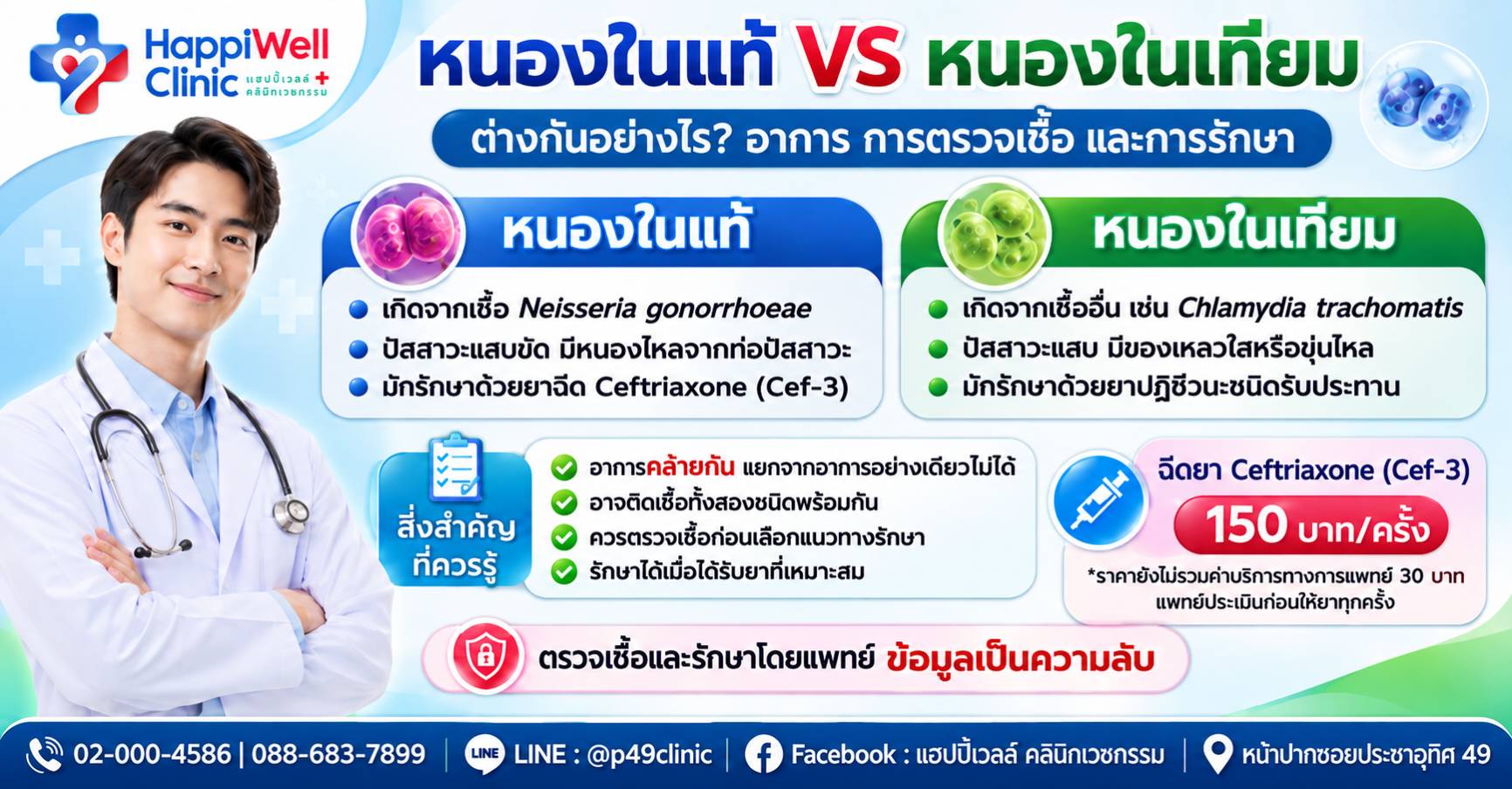
Burning when you pass urine, or pus or discharge from the tip of the penis: in Thai this is often just called "gonorrhoea". In fact there are two conditions, true gonorrhoea and non-gonococcal urethritis (sometimes called "false gonorrhoea" in Thailand). They are caused by different germs and treated differently. This article explains the difference simply.
In short
- Gonorrhoea is caused by the bacterium Neisseria gonorrhoeae.
- Non-gonococcal urethritis is caused by other germs, such as chlamydia (Chlamydia trachomatis) or Mycoplasma genitalium. It is more common than many people think.
- The symptoms are very similar and cannot be told apart by eye. A test is needed to know for sure.
- Both can be treated, but the medicine must match the germ, and you can have both at the same time.
Common symptoms
- Burning, stinging or pain when passing urine
- Pus or discharge from the urethra. In gonorrhoea it is often thick and yellow or green; in non-gonococcal urethritis it is more often cloudy white or clear and milder — but this is not a reliable rule.
- Symptoms usually start 2–7 days after exposure for gonorrhoea, and may take longer for non-gonococcal urethritis.
- Many women have no symptoms, or only unusual discharge, burning when passing urine or lower abdominal pain.
- Infections in the throat or rectum often have no symptoms but can still be passed on.
Some people have no symptoms but can still pass the infection on. If you have had a risk, get tested even if you feel fine.
Why test? Can I just buy antibiotics?
- The two conditions need different medicines. Guessing can mean the wrong drug: symptoms may seem to ease while the germ is still there.
- Gonorrhoea is becoming more resistant to antibiotics worldwide. Taking the wrong dose or course makes this worse.
- You can have both infections at once, so doctors plan treatment from the test results and your risk history.
- A test also helps the doctor decide whether to check for other infections such as HIV and syphilis.
What HappiWell Clinic offers
- Testing: the doctor takes a history, examines you and sends tests as appropriate. See our STI screening page.
- Treatment: for gonorrhoea the main treatment is a single injection of the antibiotic Ceftriaxone (Cef-3); the doctor may add tablets depending on your results. See the Ceftriaxone injection page for the price.
- For non-gonococcal urethritis, the doctor usually prescribes antibiotic tablets matched to the germ suspected or found.
- Free condoms in all sizes.
Your information is confidential. Your visit and results are kept private, and questions — on LINE or at the clinic — are answered only by our doctors and nurses.
After treatment
- Finish all the medicine as prescribed, even if you feel better.
- Avoid sex until treatment is finished and symptoms have gone — generally at least 7 days after you received the medicine.
- Your partner(s) should be tested and treated at the same time, or you can pass the infection back and forth.
- See the doctor again if symptoms do not improve within 3–5 days or come back.
- The doctor may advise tests for HIV, syphilis and other infections too.
- Use condoms every time to avoid re-infection.
What happens if it is not treated?
- Men: inflammation of the testicle or epididymis, prostatitis, narrowing of the urethra.
- Women: pelvic inflammatory disease, blocked tubes, risk of infertility and ectopic pregnancy.
- Rarely the germ spreads to the blood or joints, and having an STI makes it easier to catch HIV.
- Pregnant women can pass the infection to the baby during birth.
Prices at HappiWell Clinic
- Ceftriaxone (Cef-3) injection: 150 baht per injection
- Testing: ask about tests and prices on LINE @p49clinic or see the STI screening page.
Prices do not include the medical service fee. A doctor takes your history and assesses you before any medicine is given.
To consult or book, message us on LINE @p49clinic. We are open every day: Monday–Friday 08:00–18:00 and Saturday–Sunday 08:00–12:00.
Frequently asked questions
Can I tell the two apart myself?
No. The symptoms are very similar. A doctor needs to examine you and test for the germ.
Does one injection cure it?
Gonorrhoea usually responds well to a single Ceftriaxone injection, but the doctor will decide whether other medicine is needed and may ask you to come back for follow-up.
Can it go away on its own?
Do not wait. Symptoms may ease while the germ stays, and you can still pass it on or develop complications.
Should I tell the doctor about antibiotic allergies?
Always — especially allergy to penicillin or cephalosporin antibiotics.
References
- CDC – STI Treatment Guidelines: Gonococcal Infections Among Adolescents and Adults
- CDC – STI Treatment Guidelines: Urethritis and Cervicitis
- WHO – Gonorrhoea (Neisseria gonorrhoeae infection)
This article is for general information and is not personal medical advice. If you have symptoms, see a doctor for testing and treatment.